

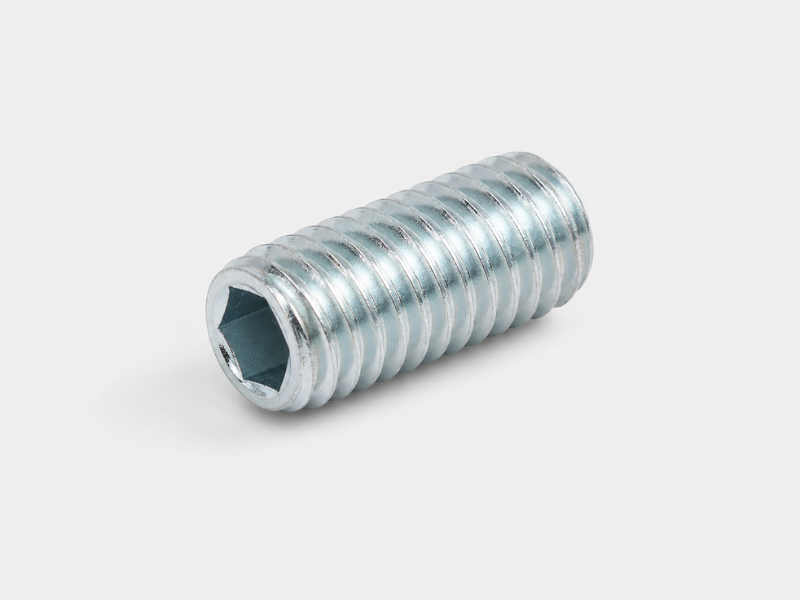
Industrial set screws are fastening components used for locking and positioning mechanical components within shafts, hubs, pulleys, couplings and transmission elements.
Also known as headless screws or grub screws, they are screwed completely into the threaded seat and operate by applying controlled pressure to the component to be locked. This configuration makes it possible to create compact connections with no external protrusions, suitable for mechanical assemblies subject to rotation or limited installation space.
Their main function is not to generate the preload typical of structural fasteners, but to prevent unwanted movement, maintain the correct positioning of components and contribute to torque transmission in mechanical systems.
Characteristics of Industrial Grub Screws
Set screws are generally manufactured with full thread and a hexagon socket drive, a solution that allows easy assembly even in confined spaces.
Compared to other types of fasteners, they offer the advantage of being installed completely inside the component without altering its external dimensions. This characteristic makes them particularly common in transmission systems, gearboxes, automation equipment and machine tools.
The choice of grub screw must take into account not only the dimensions, but also the operating conditions, the material of the mating parts and the expected frequency of maintenance or disassembly.
Types of Grub Screws According to ISO 4026, 4027, 4028 and 4029
UNI EN ISO standards define the main configurations of hexagon socket set screws.
ISO 4026 – Flat Point Grub Screws
The flat point ensures uniform pressure distribution on the contact surface and is suitable when deformation of the clamped component needs to be limited.
ISO 4027 – Cone Point Grub Screws
The cone point allows precise positioning and good resistance to displacement thanks to its localized action on the mating material.
ISO 4028 – Cup Point Grub Screws
The cup point is one of the most widely used configurations in industrial applications. Its concave geometry provides effective grip on the shaft and ensures a good balance between holding performance and ease of assembly.
ISO 4029 – Dog Point Grub Screws
Dog point grub screws are used when a precise fit with dedicated seats or machined reference points is required.
Industrial Applications of Set Screws
Industrial set screws are used in many mechanical systems where a component needs to be locked or positioned without using more complex fastening solutions.
They are used, for example, in:
- industrial gearboxes
- electric motors
- pulleys and hubs
- transmission couplings
- gears and pinions
- machine tools
- automation systems
- packaging equipment
- special industrial machinery
In these applications, correct component sizing contributes to connection stability and positioning repeatability during operation.
ISO Standards and Dimensional Requirements
UNI EN ISO 4026, 4027, 4028 and 4029 standards represent the main reference for the geometric definition of hexagon socket set screws.
These standards define nominal dimensions, tolerances, socket characteristics and dimensional parameters required to ensure interchangeability and compatibility between components.
In the most demanding industrial applications, regulatory compliance is often combined with additional requirements concerning materials, surface treatments, dimensional inspections and quality documentation.
Available Materials
Industrial set screws can be manufactured in different materials depending on the operating environment and the required performance.
The most commonly used materials include:
- carbon steels
- high-strength alloy steels
- A2 stainless steel
- A4 stainless steel
- 42CrMo4
- 39NiCrMo3
- Duplex
- Super Duplex
- Inconel and other special alloys
Material selection becomes particularly important in the presence of corrosive agents, high temperatures or applications subject to continuous vibration.
Surface Treatments
Surface treatments make it possible to improve corrosion resistance and adapt the component to the expected operating conditions.
The most commonly used treatments include:
- electrolytic zinc plating
- hot-dip galvanizing
- Geomet® and zinc-flake coatings
- black oxide treatment
- phosphating
- electroless nickel plating
- thread-locking coatings applied to the thread
The choice of treatment depends on the working environment, the required service life and compatibility with the assembly system.
EFS Capabilities
Set screws are not among the product families most frequently requested in EFS’s target market. Supplies generally concern specific requirements related to industrial machinery, technical components or particular dimensional specifications.
Thanks to its collaboration with qualified Italian and European manufacturers, EFS can support requests involving non-standard materials, dedicated treatments, additional inspections and specific technical documentation.
On request, EN 10204 3.1 and 3.2 certificates, material traceability and dimensional inspections can be managed according to the application specifications.
FAQ
What Is the Difference Between Industrial Set Screws and Headless Screws?
The two terms are often used as synonyms. In technical language, the term set screw generally identifies a threaded component intended for locking or positioning mechanical components.
In Which Applications Are Set Screws Used?
They are mainly used in shafts, hubs, pulleys, couplings, gearboxes, electric motors and transmission systems where it is necessary to prevent relative movement between components.
Is It Possible to Supply Set Screws with Special Materials or Treatments?
Yes. Depending on the application, special materials, dedicated surface treatments and additional documentation requirements may be requested.