

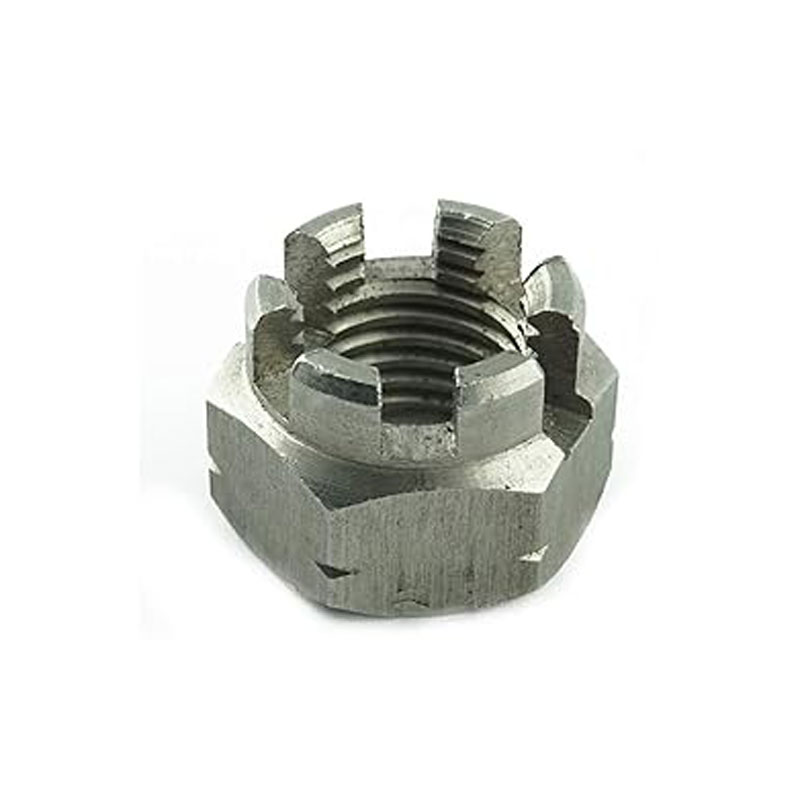
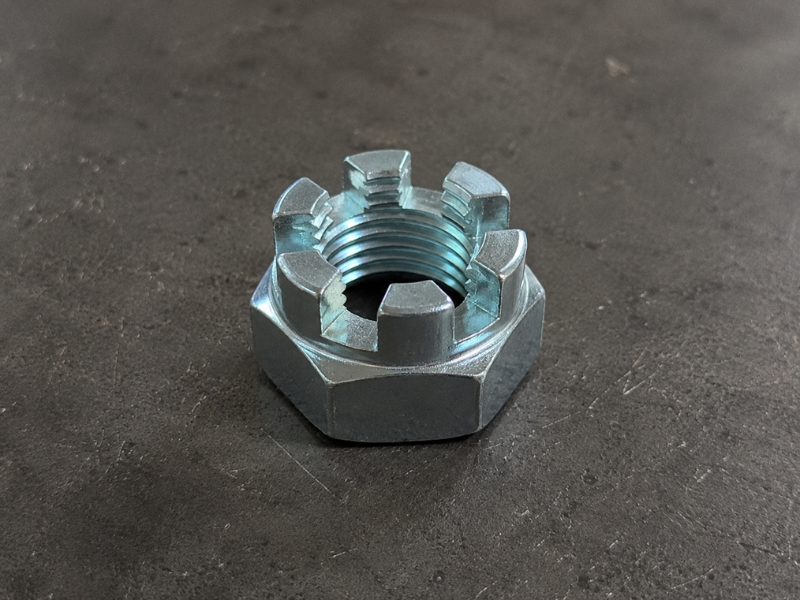
Castellated nuts are fastening components designed to prevent accidental loosening of the connection through the use of a safety cotter pin. Their distinguishing feature is the presence of slots in the upper part of the nut which, once aligned with the hole in the shank of the screw or pin, allow the cotter pin to be inserted.
This mechanical locking system is used in applications where fastening safety is a priority requirement and where vibration, alternating loads or dynamic stress could compromise tightening stability over time.
Although they are less widespread than modern self-locking systems, castellated nuts continue to be used in many industrial sectors thanks to the simplicity of the system and the possibility of visually checking that the connection has been correctly locked.
Characteristics of Crown Nuts
The function of a crown nut is not to generate additional friction on the thread, but to allow positive mechanical locking through a cotter pin.
After tightening, the slots of the nut are aligned with the transverse hole in the pin or screw. The cotter pin is then inserted and bent, preventing any unwanted rotation of the nut.
This system offers high safety against loosening, easy visual inspection of the assembly and reliability that is particularly valued in applications subject to vibration and dynamic loads.
On the other hand, it requires specifically designed components with through holes and generally longer assembly times compared to other locking solutions.
Industrial Applications of Crown Nuts
Crown nuts are mainly used on pins, axles and connections subject to continuous movement or vibration.
They are particularly common in agricultural machinery, earthmoving equipment, lifting systems, railway applications and many types of industrial equipment where the fastening system must be easy to inspect during maintenance activities.
The presence of the cotter pin allows immediate verification that the connection has been correctly locked, a characteristic that continues to make them a valued solution in many mechanical applications.
In many projects, the crown nut is chosen not so much for economic reasons, but for specific design requirements that call for a mechanical safety system independent of thread friction.
UNI and DIN Standards
Crown nuts are manufactured according to standards that define the dimensions and geometries of the component.
The main reference standards are:
- UNI 5593, relating to low crown nuts used with a safety cotter pin.
- UNI 5594, relating to high crown nuts, characterized by greater thread engagement height.
- DIN 937, the German reference standard for low crown nuts.
- DIN 979, the German reference standard for high crown nuts.
In practical applications, the choice between low and high versions mainly depends on the available space, the useful thread length and the specifications indicated in the drawing.
Main Types of Crown Nuts
The crown nut family mainly includes slotted hex nuts designed for use with a safety cotter pin.
The differences mainly concern nut height, thread pitch, nominal dimensions and the material used. In addition to standardized versions, special supplies manufactured according to dimensional specifications defined by the customer may also be required.
Available Materials
EFS can support supplies of crown nuts in carbon steel, high-strength alloy steels, A2 and A4 stainless steels, ASTM materials for Oil & Gas applications, Duplex, Super Duplex and special alloys such as Inconel and Hastelloy.
Material selection depends on environmental conditions, the presence of corrosive agents and the mechanical performance required by the application. For the most critical sectors, certified and fully traceable materials are available.
Surface Treatments
Crown nuts can be supplied with electrolytic zinc plating, hot-dip galvanizing, Geomet®, zinc-nickel coating, phosphating, black oxide treatment and other surface treatments selected according to the operating environment.
Correct surface protection helps preserve fastening durability and ensure connection reliability over time.
EFS Capabilities
EFS manages supplies of standard and special nuts through a network of qualified Italian and European manufacturers.
In addition to standardized components, supplies can be produced with special materials, dedicated treatments and specific documentation requirements. On request, EN 10204 3.1 certificates, dimensional inspections and full raw material traceability can be provided.
FAQ
What Is a Crown Nut Used For?
A crown nut is used to prevent the connection from loosening by means of a cotter pin inserted through a hole in the screw or pin.
What Is the Difference Between a Low Crown Nut and a High Crown Nut?
The main difference concerns the height of the nut and the thread engagement length. High versions provide a larger mating surface compared to low versions.
When Is It Advisable to Use a Crown Nut?
It is particularly suitable for applications where fastening safety must be easy to verify and where a mechanical locking system independent of thread friction is required.