

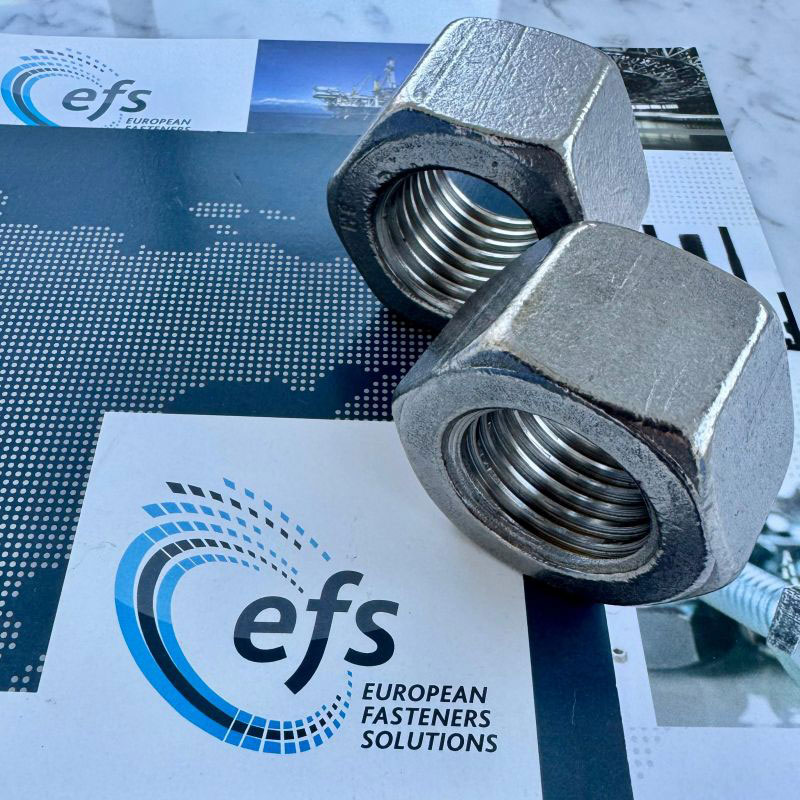
Industrial hex nuts are one of the fundamental components of fastening systems used in machinery, Oil & Gas, energy, heavy steel construction, offshore and industrial plant engineering. Although the market for standard nuts is now largely focused on imported and high-volume products, in more technical applications special nuts become particularly important, manufactured with specific materials, dedicated surface treatments or non-standard geometries.
In the most demanding industrial applications, the nut should not be considered simply as an accessory to the screw, bolt or threaded rod. The correct combination of material, thread, surface treatment and dimensional tolerances directly affects the safety and durability of the connection.
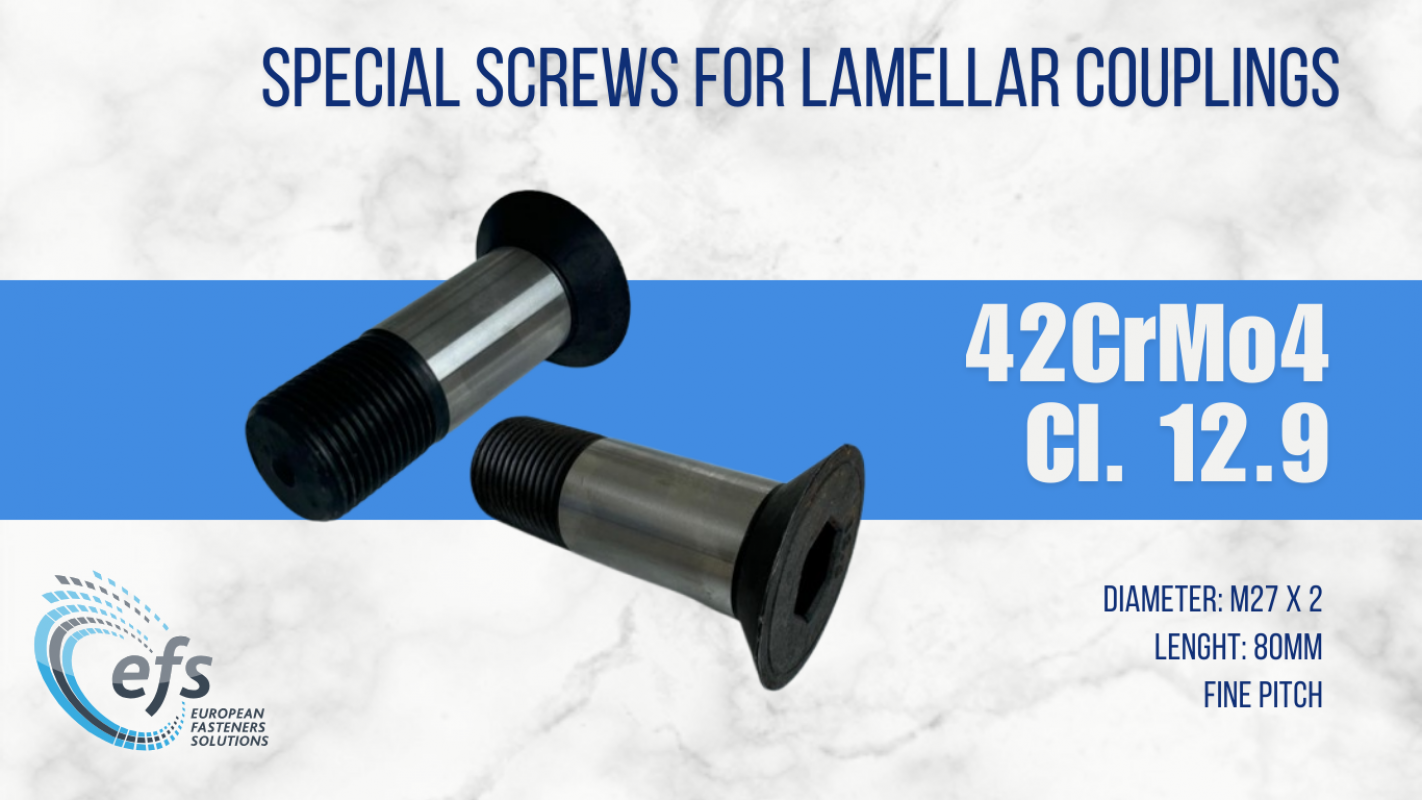
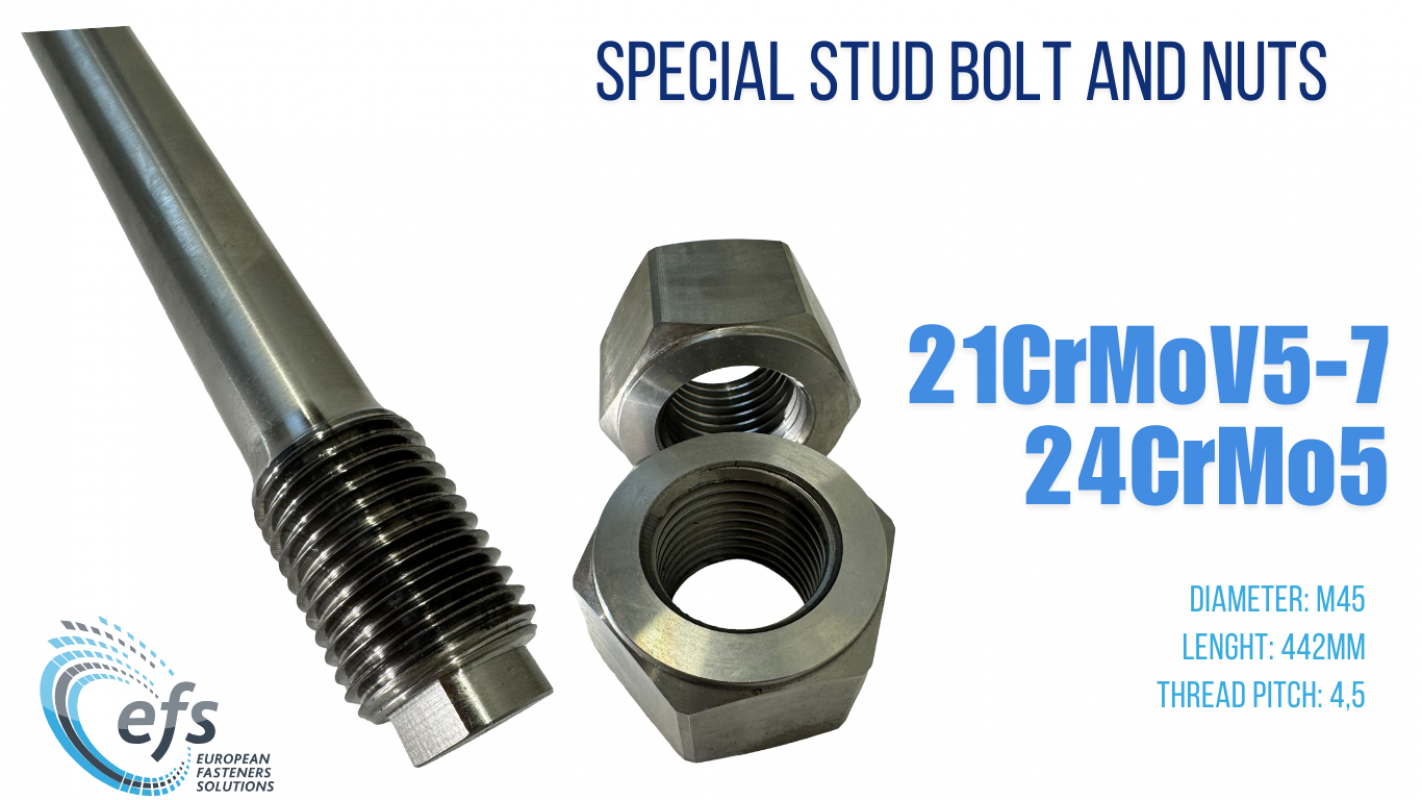
For this reason, EFS supports complete supplies of special fasteners including metric and imperial nuts, also manufactured to drawing, with 3.1 or 3.2 certification and full raw material traceability.

Characteristics of Industrial Hex Nuts
Hex nuts are manufactured according to ISO, DIN and UNI metric standards or according to ASME and ASTM imperial standards, which are particularly common in the Oil & Gas sector and in process plants.
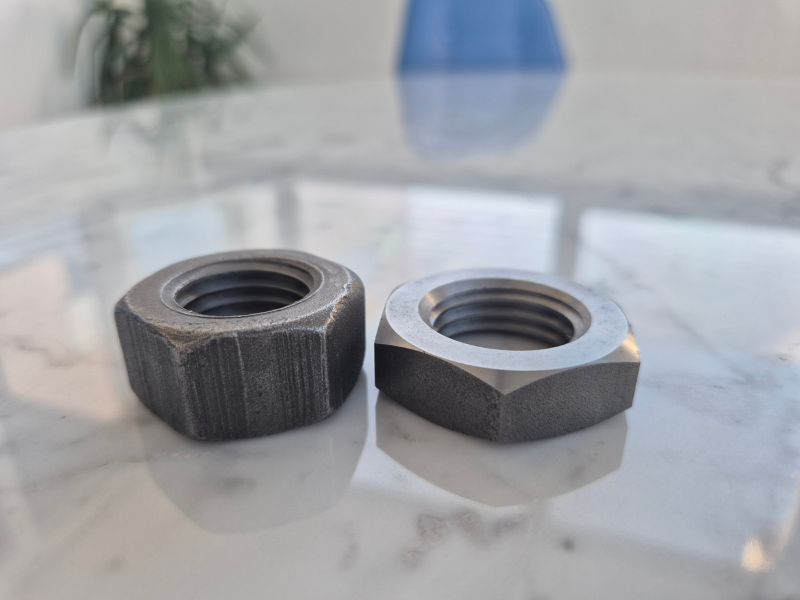
Alongside traditional standard hex nuts, specific versions are developed for particular application requirements. Thin nuts are often used as lock nuts or when the available space is limited. High nuts, on the other hand, provide a larger thread engagement surface and are suitable for connections subject to high loads or frequent assembly and disassembly operations.
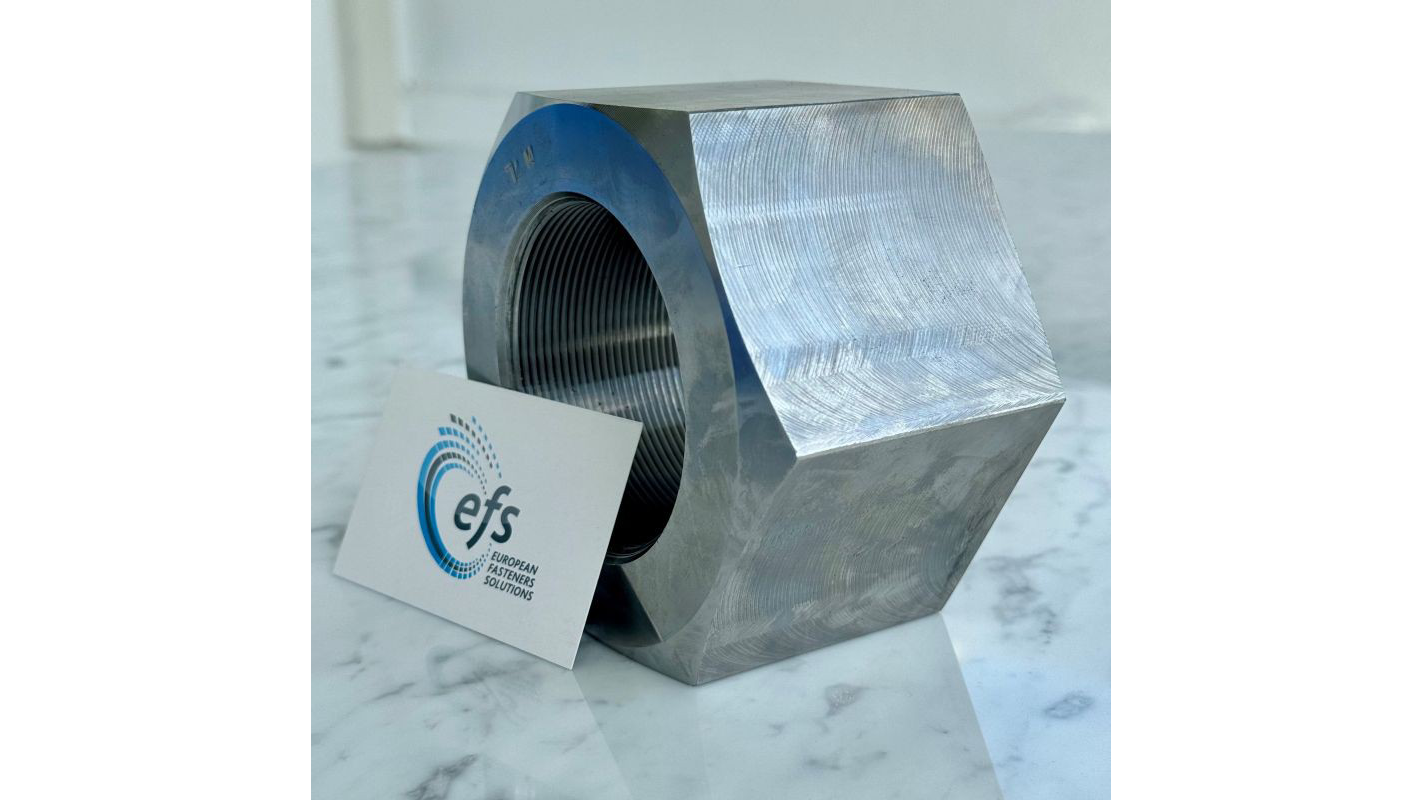
Oversize nuts represent a separate category. In these cases, the component is manufactured with larger external dimensions than those defined by standard regulations, or with fully customized threads and geometries. These solutions are common in large industrial plants, valves, heat exchangers and Oil & Gas applications.
Unlike commercial fasteners, the production of oversize nuts often requires complete machining from bar stock or solid material. On large diameters, this involves significant material removal and long machining times, especially when special alloys such as Duplex, Super Duplex, Inconel or ASTM B16 are used.
Industrial Applications of Hex Nuts
Industrial hex nuts are used in all sectors where the fastening system must ensure mechanical reliability and operational continuity.
In the Oil & Gas sector, hex nuts are used together with ASTM A193 threaded rods for tightening valves, flanges, heat exchangers and pressure equipment. In offshore and marine applications, corrosion-resistant materials such as Duplex and Super Duplex are frequently required.
In the machinery sector, they are used on gearboxes, presses, machine tools, transmission systems and automated plants, where dimensional accuracy and tightening stability are essential aspects.
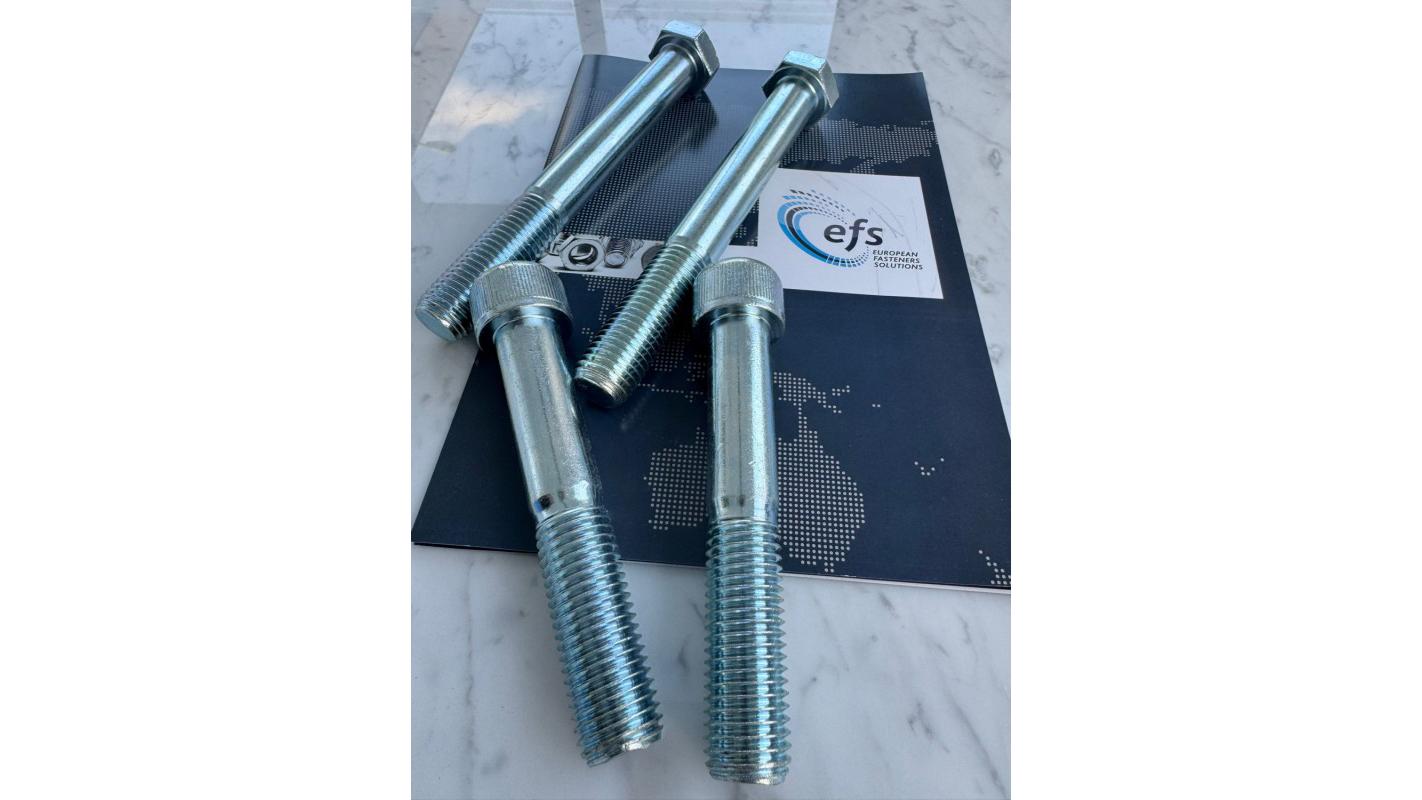
In metal infrastructure and heavy steel construction, the nut also plays a decisive role, especially when it must be combined with hot-dip galvanized screws, bolts and threaded rods designed to operate for years in outdoor environments.
ISO, DIN, UNI and ASTM Standards
The main dimensional standards for metric hex nuts are ISO 4032 and DIN 934, used to define the dimensions, tolerances and geometric characteristics of standard hex nuts.
For thin nuts, the most common references are ISO 4035 and DIN 439, while ASME B18.2.2 and ASTM standards are widely used for the North American market and the Oil & Gas sector.
ASTM A194 is particularly common for nuts intended for high-pressure and high-temperature service. ASTM A194 grades 2H, 7, 7M, 8 and 8M are frequently combined with ASTM A193 B7, B16, L7, B8 and B8M threaded rods in petrochemical, energy and offshore plants.
When working with imperial fasteners, it is essential to verify compatibility between nut and threaded rod not only from a dimensional point of view, but also in terms of material, mechanical grade and surface treatment.
Types of Industrial Hex Nuts
The most commonly requested types in industrial applications include standard hex nuts, thin nuts, high nuts, ASME heavy hex nuts, ASTM nuts for Oil & Gas applications, and special nuts manufactured to drawing.
For special supplies, EFS also manages oversize hex nuts, UNC, UNF and 8UN threads, customized geometries and components intended to be paired with non-standard threaded rods and studs.
Available Materials
Material selection depends on the operating conditions and on the fastener with which the nut must work.
For standard industrial applications, carbon steels and quenched and tempered alloy steels in classes 6, 8, 10 and 12 are commonly used.
In the Oil & Gas, offshore and energy sectors, materials such as ASTM A194 2H, Grade 7, 7M, 8 and 8M, Duplex, Super Duplex and AISI 304 and AISI 316 stainless steels are frequently used.
For particularly aggressive environments or high-temperature conditions, special alloys such as Inconel, Hastelloy, Monel and Incoloy may be used.
Surface Treatments
The surface treatment of the nut must be evaluated together with the screw, bolt or threaded rod with which it will be assembled.
The most commonly used treatments include electrolytic zinc plating, hot-dip galvanizing, Geomet®, zinc-nickel coating, phosphating, electroless nickel plating and fluoropolymer coatings such as Xylan®.
A particularly relevant case is that of HDG hot-dip galvanized nuts. The coating thickness modifies the thread engagement conditions and may require the production of oversized threads or subsequent re-tapping of the internal thread.
Correct management of these tolerances is essential to ensure assembly and proper tightening of the screw-threaded rod-nut system. For this reason, in structural applications and metal infrastructure, the HDG nut must be designed as an integral part of the entire fastening system.
EFS Capabilities
EFS supports supplies of technical standard and special industrial hex nuts, with particular focus on applications where the nut is a critical component of the connection.
The activity includes the management of special made-to-drawing nuts, oversize nuts, metric and imperial threads, special materials, surface treatments and 3.1 and 3.2 certifications.
Thanks to a qualified network of European manufacturers, EFS coordinates the entire production chain, ensuring traceability, dimensional inspections and complete technical documentation.
FAQ
What Is the Difference Between a Thin Nut and a High Nut?
A thin nut is generally used as a lock nut or when the available space is limited. A high nut provides a longer thread engagement length and is preferred in applications subject to high loads.
When Are Oversize Nuts Used?
Oversize nuts are used when the required dimensions are not available in standard regulations or when the project requires specific geometries. They are widely used in the Oil & Gas sector, in valves and in process plants.
Do Hot-Dip Galvanized Nuts Need to Be Oversized?
It depends on the applicable standard and the coating thickness. In many cases, oversized or re-tapped threads are required to ensure correct coupling with hot-dip galvanized threaded rods and screws.
Is It Possible to Manufacture Special Made-to-Drawing Nuts?
Yes. Nuts can be manufactured with non-standard dimensions, special threads, specific materials, dedicated treatments and certifications for critical industrial applications.